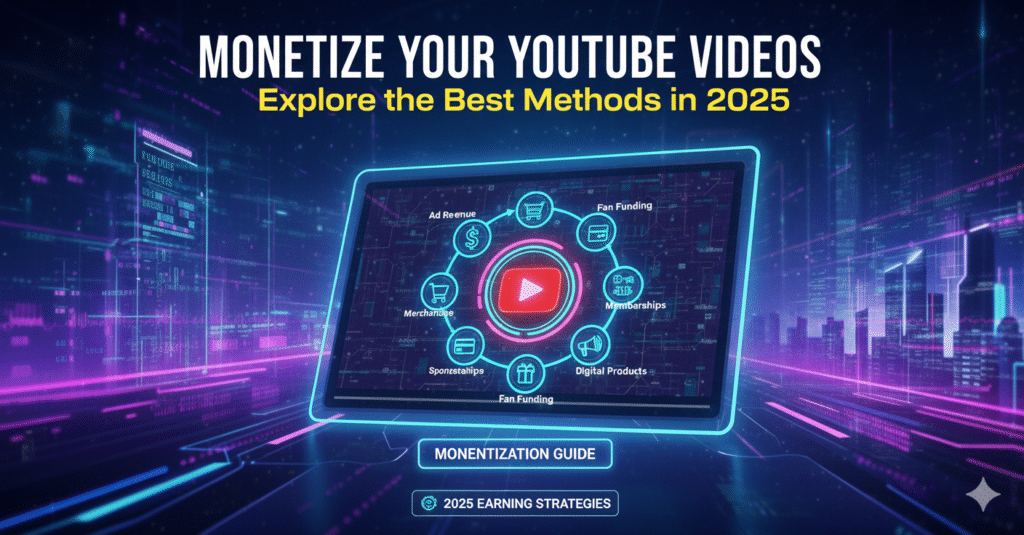
There are seven distinct ways a YouTube channel earns money. Most creators use one of them, which is why most creator income is far more fragile than it needs to be. This is an overview of all seven, what each requires, and where each one fits.
1. Advertising revenue
Requires: Partner Program membership — 1,000 subscribers plus either 4,000 public watch hours in 12 months or 10 million Shorts views in 90 days.
You receive 55% of ad revenue on long-form video and 45% of your allocation from the Shorts pool. It is the most passive stream and the most volatile — rates swing seasonally and vary widely by niche and audience geography.
Treat it as a foundation rather than a plan. For most channels it is the smallest stream per viewer.
2. Channel memberships
Requires: Partner Program membership and, generally, a larger subscriber base.
Viewers pay monthly for perks — badges, emoji, members-only content. Revenue is recurring and predictable, which makes it disproportionately valuable compared with the same amount from ads.
It works where viewers return for you rather than for individual topics.
3. Super Thanks, Super Chat and Super Stickers
Requires: Partner Program membership.
Direct viewer payments on videos and during live streams. Modest for most channels, but meaningful for live-heavy formats where the payment also buys visibility in chat.
4. Affiliate revenue
Requires: nothing. Available from your first video.
You earn commission on purchases made through your links. This converts on genuine demonstration — a tool shown solving a problem, not a list of products.
Per-viewer earnings frequently exceed ad revenue by a wide margin, which is why it is the usual first step for new channels. Disclosure is legally required.
5. Sponsorships
Requires: a defined audience. Not a large one.
Brands pay for access to a specific audience, and niche channels often command better rates per viewer than large general ones because conversion is higher.
Price on median views across recent videos rather than subscriber count. Sponsors are buying predictable delivery, not a headline number.
6. Your own products
Requires: a problem your audience repeatedly asks about.
The highest margin of any stream, because there is no revenue share. Digital products suit creator audiences best since fulfilment costs nothing.
Merchandise is the more visible option but carries inventory or print costs and generally requires stronger audience identification to sell well.
7. Services
Requires: a demonstrable skill.
The stream most often overlooked and frequently the fastest to meaningful income. If your videos show you doing skilled work, they function as a continuously running portfolio.
It needs the fewest viewers of anything on this list. A small number of clients can exceed what ads would pay at far greater scale.
How they fit together
Streams 4–7 need no eligibility threshold and can start immediately. Streams 1–3 require the Partner Program and arrive later.
That ordering matters, because most creators wait for the Partner Program while ignoring four streams already available to them.
A reasonable structure for an established channel: ads as a baseline, one or two audience-funded streams for predictability, and a product or service carrying the largest share.
Working out what you would earn
Published earnings figures are unreliable because CPM and RPM are routinely confused and rates vary by quarter. Use your own numbers.
Our YouTube Earnings Calculator estimates ad revenue from views and niche, and the CPM and RPM Calculator shows the difference between what advertisers pay and what reaches you.
What each stream requires before it can pay you
The streams above are not equally available. Some need a programme threshold, some need only an audience, and some need a product that does not exist yet. Knowing which is which prevents a lot of wasted effort.
- Needs YouTube Partner Programme acceptance: advertising revenue, channel memberships, Super Thanks and Super Chat. These have subscriber and watch-hour thresholds that YouTube sets and periodically revises — check the current figures in Studio’s monetisation section rather than trusting a number quoted in an article.
- Needs only an audience and disclosure: affiliate revenue and sponsorships. Both can begin at any channel size. Both carry a legal obligation to disclose the commercial relationship clearly.
- Needs something to sell: your own products and services. No platform permission required, but the work sits outside YouTube — the channel supplies attention, not the offer.
The practical consequence is that a channel waiting on the Partner Programme is not blocked from earning. It is blocked from earning through three of seven routes.
Diversification is about risk, not just income
Multiple streams are usually framed as a way to earn more. The stronger argument is that they make income less fragile, because each stream fails in a different way and for different reasons.
- Ad revenue moves with advertiser demand and the calendar — outside your control, and it falls every January.
- Sponsorships move with individual companies’ marketing budgets, and tend to dry up in the same conditions that depress ad rates.
- Memberships and direct support move with your relationship to a small committed group, which is slower to build and slower to lose.
- Products and services depend on your own delivery capacity rather than on anyone else’s budget.
A channel earning entirely from advertising is exposed to a single market it cannot influence. A channel earning from three sources with different failure modes absorbs a bad quarter in one of them. That is the actual case for diversifying — not that seven streams beat one, but that they rarely fail together.
The trap is starting all of them at once. Each has setup work and ongoing obligations, and a half-built membership tier with three members costs more attention than it returns. Add the next stream when the current one is running without you.
The short version
Seven streams exist; four need no threshold at all. Ads are the most passive and the most volatile. Products and services pay most per viewer. A channel relying on a single stream is more fragile than its income suggests.